When I first got into bass fishing I found myself buying a lot of equipment and trying out different rods. In some instances I ended up with a case of buyer’s remorse, so I figured I’d share some tips and hopefully save you some time and money. So with that being said, let’s get into the six things you should consider before you buy a new rod.
Number One – Budget
As time has passed and I’ve tried more and more rods I’ve noticed there tends to be a ‘sweet spot’ in terms of purchase price and overall value. I’m sure this is going to vary depending on the individual, but in my case I’ve found that I really like rods in the $150 -$400 range and once you go past that you start to get into diminishing returns where you might still see a little improvement as the price continues to go up, but the amount of improvement vs the amount spent goes down. I guess what I’m trying to get at is that like a lot of things, you generally will get what you pay for when it comes to fishing rods, but you might also find a point that feels like the sweet spot. Anything above that will feel too expensive in terms of what you are getting back, and anything under it just won’t feel good enough. I’ll get into the specific rods and reels I like more as time goes on but for now I guess I’ll just say keep this in the back of your mind, and generally speaking rods in this price range have done well for me.
Number Two – Rod Power & Action
I’ve seen people buy the wrong type of rod before so I thought I’d mention this one as well. There are a lot of articles and videos on this subject out there and I can remember feeling like some of the explanations were vague and ambiguous, so I figured I’d try to briefly explain what each of these are and why they are important. Without going into too many details I’d argue that you can start by thinking of one word…load. Now that we have that in mind, let’s just clarify something. When I say how much weight it takes before the rod ‘loads up’ I simply mean how much weight it takes before you see a significant amount of bend in the rod.
Now that we have that out of the way let’s talk about power first. Power is pretty easy and you can think of rod power as how much weight it takes (or how heavy of a lure it takes) for your rod to load up. So for example if you want to throw a 1.5oz swimbait you will probably want to go with a heavier power rod since a light rod would bend too soon and feel like a noodle. To make things even easier most rod manufacturers also provide you with minimum and maximum lure weight ratings these days. The weight ratings can be very useful (although not always perfect), and generally speaking if you are going to get a rod for a specific lure, you should figure out the weight of that lure. Once you have that you want to add up the minimum lure rating on the rod and the maximum lure rating and divide that number by two and hopefully that lure weight is just about that same number. Please keep in mind not all rod manufacturers always get these ratings right, but I’d argue this is a good place to start until doing this becomes a little more intuitive for you.
The action of the rod is also important, and you can think of action as the point on the rod where it starts to bend when it loads up. Generally speaking a rod with a fast action rod will bend more towards the tip of the rod, while a moderate action will bend more towards the middle. So in order, the bend point on an extra fast would be closest to the tip, followed by fast, then moderate fast then moderate. Slow is after that and would have a load point closest to the reel, but you don’t really see slow action bass rods.
Now that we have cleared that up in addition to figuring out the power of the rod you want…which as a reminder would be based on the weight of the lure(s) you are going to throw with it, you then want to select the appropriate action, which is going to be based on the type of lure that you throw. For example, if you are going to throw a frog you aren’t going to want to use a moderate rod as you are going to need to drive two large hooks into the mouth of some unsuspecting fish, and so you would want a rod with a faster action since that will help apply more force to your hooksets. On the other hand, if you are going to use a lure with treble hooks like a crankbait, then a moderate or moderate fast rod would probably work better than a fast once since it doesn’t take much force to hook the fish, and the extra bend will help after the fish is hooked and you are reeling the fish back to the boat since it will be harder for the fish to shake the hook out of it’s mouth. There’s a ton of more info out there on this subject, but for now I’ll simply suggest that you pay attention to the action and power of any rod that you are thinking about purchasing, and think carefully about they type of lures and corresponding weight of those lures you are planning on throwing with it before you buy it.
Number Three Handle Design and Location
This one is more for spinning rods then casting rods and I mention it because I actually bought the wrong type before and ended up regretting it. Fortunately I was able to sell that one easily and more on that in a moment but for now consider this picture:
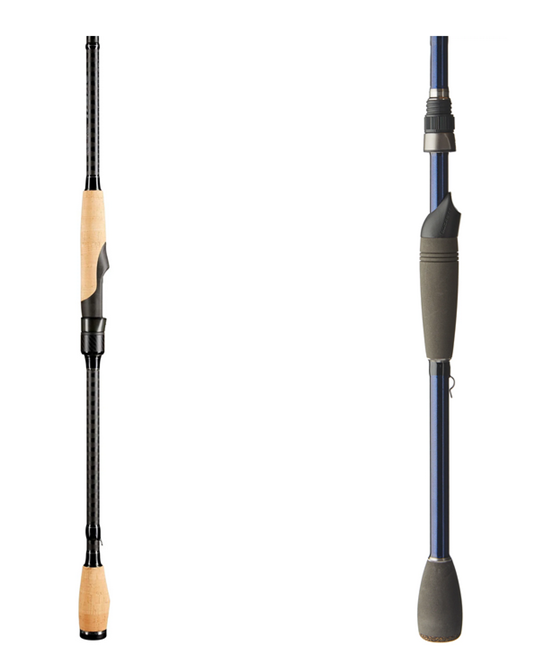
These are both spinning rods but as you can see they look just a bit different. I have not used either of these before, but the one on the left is a Level Fishing NGX, and the one on the right is a Duckett Jacob Wheeler 2.0 Series. The one on the left has what’s known as a foregrip, while the one on the right has what’s commonly referred to as a split grip. I bring this up because if you are going to buy a spinning rod you should really pay attention to how you actually prefer to hold a spinning rod and then make sure the rod(s) you buy correspond to that. In my case I prefer to hold my spinning rods the same as my casting rods with my hand under the reel, so I would want to buy a spinning rod with a split grip. Don’t be like me and buy one with a foregrip just because some guy on youtube said it was the best for <insert technique here>. On the other hand, if you prefer to have your hand above the spinning reel then you would want to go with one that has a foregrip. On a side note, it seems like many of the rod manufacturers out there believe most people that are going to buy more expensive rods actually prefer a foregrip based on the current selection available, but you can find good rods in each category and at least I’m in good company with Jacob Wheeler and Gary Dobyns.
Number Four – Handle Type
Another thing you may have noticed about those two spinning rods is the handle material is different. The Level Fishing NGX is cork, while the Jacob Wheeler is high impact eva foam. There are actually a few other handle types as well so I’ll just list all the ones I’ve seen:
EVA Foam – This is a common one and feels like the packing material you get in some boxes. Some people really like it but I wouldn’t say it’s one of my favorites. That doesn’t mean it’s bad I personally just like other handle types.
Winn Grips – This stuff feels similar to what you might find on a baseball bat or a golf club. It has more of a rubber type of a feel to it, but I do like it for certain techniques (eg. a frog) where you need to swing for the fences.
Cork – Cork has a nice feel to it and tends to give you a bit more sensitivity than some of the other handle types. The downside is it can wear over time. You can buy some cork seal and apply that to prevent wear and tear and I’ve been doing that with the ones I’ve got. Overall I think cork is a good option and several of the rods I currently own have cork handles.
Carbon Fiber – If sensitivity is important then my personal favorite is carbon fiber. Rods with this type of a handle are usually a bit more expensive, but I still like them for finesse lures or bottom contact lures where a lot of sensitivity is required. On the other hand if you are throwing a spinnerbait or a crankbait then you might not necessarily need a carbon fiber handle…but it still won’t hurt anyway.
Number Five – Warranty
In terms of warranty options I’ve noticed that for the most part there seem to be two types of offerings out there. The first is the standard ‘we will replace it if it was our fault and there was a defect’ type of warranty. The second is the ‘we will replace it for a fee and don’t care how you broke it or who’s fault it was’. I prefer the second type of a warranty, so most of the brands I go with offer that type of a warranty. On the other hand I’ve only had one rod that I ever needed to contact a manufacturer about so I can understand why some people don’t care about the warranty as much.
Number Six – Resale Value
Remember that rod with a foregrip? I sold it on facebook marketplace in under a week. Ultimately it cost me a few bucks, but it wasn’t the end of the world and that brings me to my last point, which is that some rods do better in the resale market than others and generally speaking brands with good name recognition or rods with a better warranty that is also transferrable to the new owner tend to do better than brands that aren’t as established or don’t offer any sort of a warranty to the new owner.
And those are a few of the things I wish I could have told myself before I got into bass fishing and bought several rods that I ended up selling shortly after I bought them. Fortunately that doesn’t really happen much these days, and hopefully this post might at the very least keep you from having the same thing happen once or twice. Until next time…