We’re in the middle of topwater season (which I consider to be late spring through early fall) and if you haven’t already been throwing a topwater lure you are missing out as some of the blow ups that you can get aren’t like anything else that you experience in bass fishing. There’s a lot of topwater lures out there and I’ve already spent some time going over some of the specific brands and models that I use, but one thing that doesn’t seem to get talked about as much these days is color selection. I personally work full time and only go fishing two to four times per week on average so I don’t necessarily feel like I need to own every color that’s available in every lure that I like, but I do want to make sure that the selection of colors that I have available is going to be sufficient for the situations I’m experiencing. So without further ado, here’s a list of the topwater colors I’m currently using.
Situation #1 – The Pond
I usually frequent a couple of smaller ponds. Most of the forage in these spots is bluegill, which makes lure selection very easy as I’m basically going to go with a popper here. I suppose I could consider a walking bait, but these spots are both very small so I don’t really need to cover water and typically find myself targeting specific spots and then wanting to pick them apart for a bit. This is where a popper shines for me, and color selection is also pretty easy for this scenario and I’m either going to go with a solid bluegill color, or a translucent bluegill color. There are a few different popper models out there that I like at the moment, and as it turns out they all seem to offer lures in both of these colors (go figure). For example, if you look at the Duo Realis Popper 64 you will see it’s available in ghost gill and prism gill. Case closed for me. Ok honestly just about all of the colors they have for this lure look awesome and I’m willing to be they would all catch fish at one point or another, but for a small pond scenario where they are eating bluegill this is what I’m usually throwing.
Situation #2 – The Larger Pond / Small Lake
Another spot I like to fish at on a regular basis is a smaller lake. There’s shad in this lake and it’s also larger so for this situation I’m usually going to start with a walking bait to cover water. If I find a spot that seems like it’s really good then I might switch over to a popper, but most of the time I’m usually going to stick to the walking bait here. The water here is also always stained (in fact I’ve never seen it when it wasn’t). Given that, lure selection is super easy for this scenario and I’m going to go with a bone colored walking bait or a bone colored popper if I find a spot I like.
Situation #3 – The Big Lake
That last one was a little too easy but fortunately there’s another spot I like and while it’s similar to the small lake, it’s also different in that the water visibility varies and the lake itself is also a lot larger. The lure selection itself is the same here, but since the water goes from clear to stained there are a couple of other colors I’ll mention. The first color I’ll mention is still going to be a solid white color, but for this spot I also like to keep a few other options available. Fortunately for me there’s no shortage of color options for topwater lures, and as an example here’s a few of the Lucky Craft Sammy 100s I’ve got on hand at the moment:
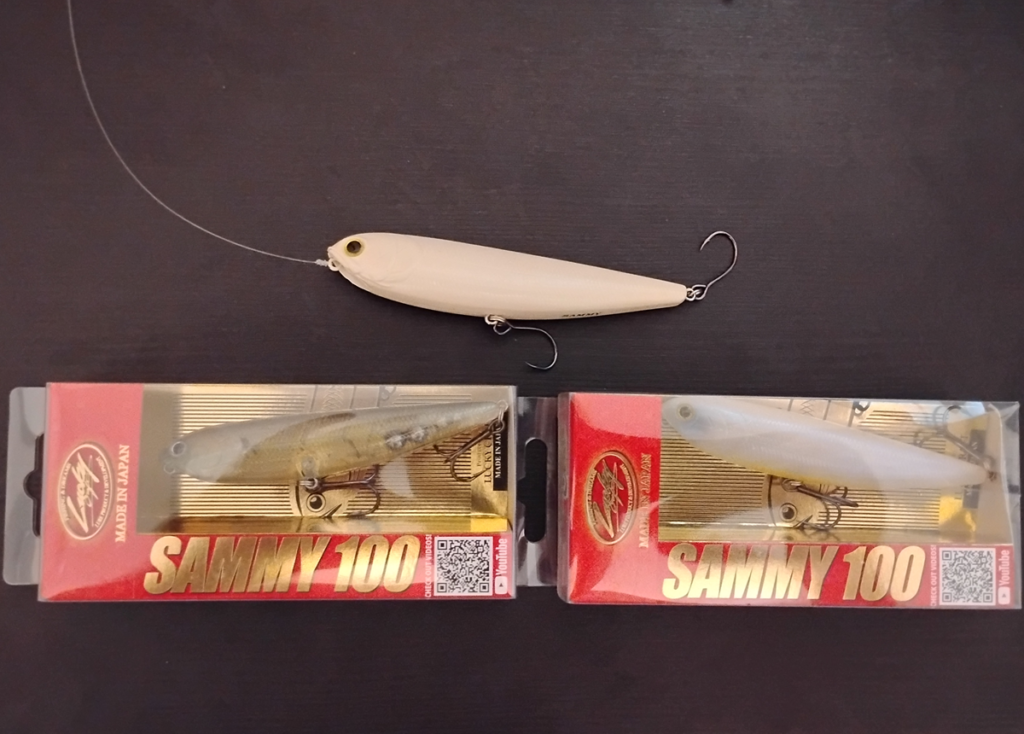
We’ve already gone over the bone color (notice this is also the one that’s actually tied on at the moment), but as you can see I do have a couple of different colors underneath it. That one on the left is called phantom chartreuse and if you ever happen to see that color somewhere my advice would be to just buy it and ask questions later. That other color is actually something that I would still consider a ‘bone’ option but in this case it’s called french pearl ob and it’s a little more translucent and has a hint of chartreuse to it.
That brings me to I guess what I’d consider to be the thesis of this post, which is you really only need enough colors to cover the situations that you are going to be encountering on a regular basis. In my case that leaves me with two to four colors for poppers, and another two to three colors for walking baits. For poppers I definitely like to keep a translucent bluegill type of a color for the small pond when it’s clear and the visibility is high. In these type of conditions when the visibility is high translucent colors are a good choice and so regardless of whether it’s a popper or a walking bait that would be my first choice.
The second color that I like to go with is what I’ll refer to as the middle ground. For example if I’m on the big lake and the water is a little stained but it’s also a little windy and it’s partly cloudy then I probably wouldn’t want to go with a translucent color, but I also wouldn’t necessarily want to go with something like a bone colored lure either. For these situations I usually like to either go with something that has a little flash, or a natural looking color. So when I’m at one of the small ponds this is going to be the prism gill color that I mentioned earlier, or if I’m at the larger lake where they are chasing shad but still throwing a popper I’d probably go with something like their prism smelt color. This is an awesome color as it’s got some flash to it (sort of like a chrome colored lure) but it’s also a pretty realistic color in terms of matching some kind of shad. Standard chrome colors can also work here, but I personally like the ones like this that have some chrome to them but are also a little more realistic / natural looking. For the Sammy this would be something like their american shad color, but between you and me I’ve got my fingers crossed that they come out with a Sammy in mh ghost minnow which is one of my favorite Lucky Craft colors and very similar to Duo’s prism smelt color.
The last color that I like to go with for topwater lures is your standard bone color. You can certainly mix this up a bit, and that french pearl ob color would be a good example of that, but when in doubt you can’t go wrong with a standard bone colored lure and there’s a reason why they sell so well. This is typically going to be my color of choice if the visibility is lower and they are feeding on shad. Alternatively, in my case the water never really gets as dirty in the small ponds I go to, so for bluegill options a standard / natural bluegill color (that isn’t translucent) is enough for me here.
One last thing I’ll point out before I wrap up here is there are definitely other color options out there, and I am not saying the colors I’ve mentioned are the best or the only ones that you need or anything like that. I’m basically saying if you are like me and want to give yourself enough color options without going completely overboard it can help to make a list of the possible situations you are going to experience and then plan accordingly. I also didn’t cover frogs in this post. That might be a topic that I cover in another post at some point, but for frogs I basically just use two colors as that’s been enough in terms of options that I need.